


Overview
Every term, students at our university had to hand-build a class schedule that satisfied dozens of constraints — required courses, time conflicts, preferred professors — often while trying to sync up with friends. It was slow, error-prone, and mentally exhausting. AnimoSched is a semi-automated scheduling tool that uses a Boolean satisfiability (SAT) solver to generate valid schedule options from a student's preferences, cutting out the tedious parts of the process while leaving the final call in their hands. I led UX research and built four of the six pages as one of two developers on a four-person team. We validated the system in a controlled study with 42 students and published the results at CHI 2021 — as, to our knowledge, the first fully Filipino-authored paper at the conference.
The Problem
Talking to students surfaced three consistent pain points in schedule-building:
- Inefficiency and redundancy — sorting through every offered class and manually checking for time conflicts, over and over.
- Information overload — juggling professor preferences, time slots, and workload balance across dozens of open tabs.
- Error-proneness — conflicts and typos that went unnoticed until it was too late to fix them. The question we designed around: how might we help students make faster, less stressful scheduling decisions — without taking the decision away from them entirely?
Research
Before touching a design tool, we needed to confirm the problem was real and understand it from the students' side. I led the team through a three-phase need-finding process:
- Survey (54 respondents) to map how students actually build schedules today, what tools they reach for, and where the friction lives.
- Semi-structured interviews (16 participants), which I moderated, digging into the more surprising or unexpected survey responses.
- Contextual inquiry (5 participants), watching students build a real schedule end to end to catch friction they wouldn't think to mention. I led the synthesis of that data into affinity diagrams, user personas, and customer journey maps, and compiled student scheduling preferences — time, day, professor, proximity, course priority, workload — into a taxonomy that directly shaped which preferences the system would let users specify.
What I Built
As Lead UX Researcher, I designed the testing protocol the team followed throughout, moderated the majority of interviews, and led synthesis of the findings into design direction.
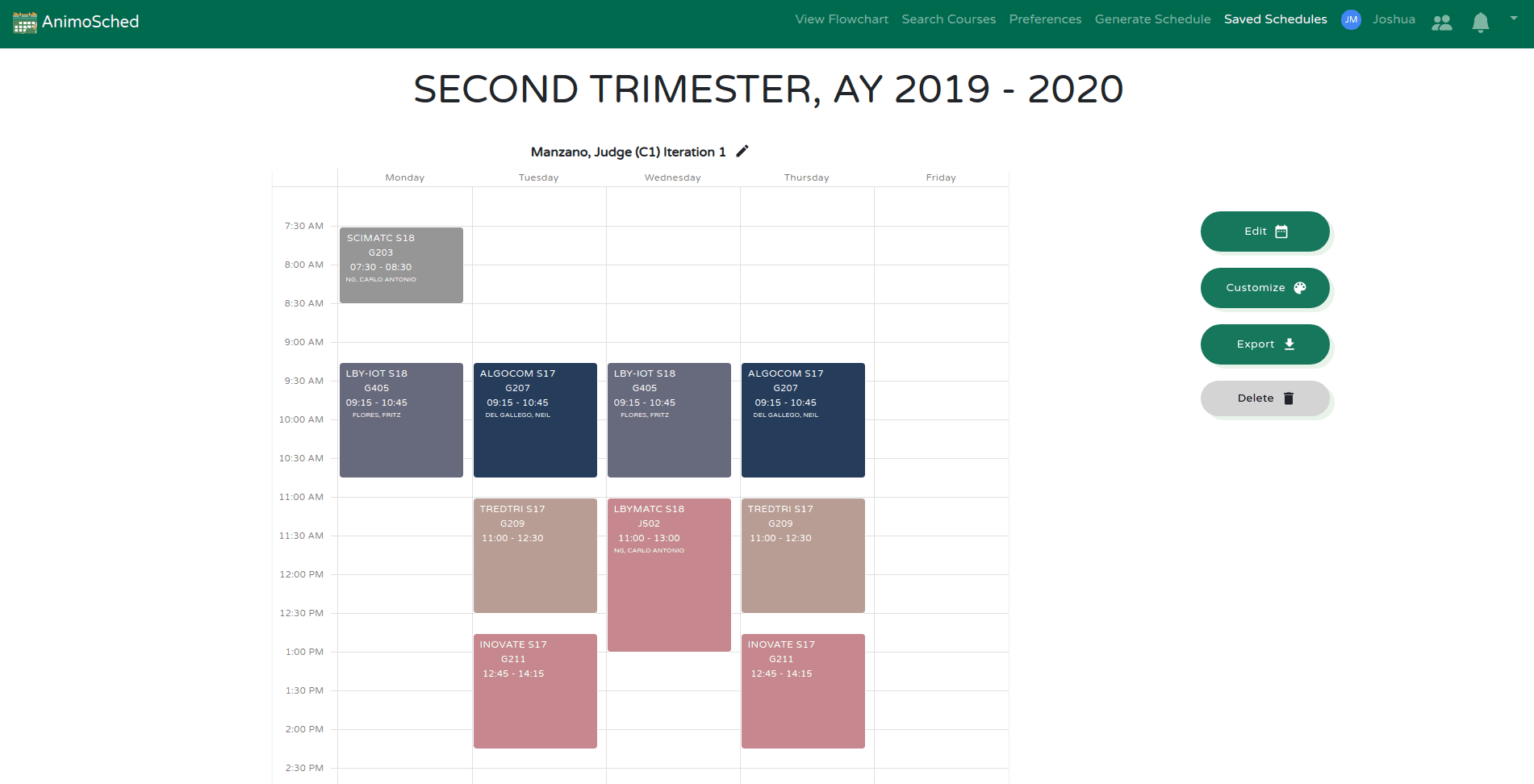
As frontend developer, I built four of the six pages in the React.js application, focused on the two hardest interaction problems in the product: rendering the generated schedule visually, and structuring the preference input fields that fed the SAT solver.
We prototyped in Figma, tested with real students, and iterated the design before validating the final build against how students normally schedule on their own.
Results
We ran a controlled study with 42 students split into a control group (using their own usual methods) and an experimental group (using AnimoSched), then measured outcomes with NASA-TLX, PANAS, UEQ, and SMEQ.
- Lower cognitive load: perceived workload dropped significantly for the experimental group (NASA-TLX) — students described tasks like conflict resolution as "easy" instead of "difficult."
- Less stress: both PANAS and NASA-TLX frustration scores showed a significant drop for students using the system.
- Faster decisions: students completed schedules in meaningfully less time than the control group, with our own product metrics showing a 43.21% reduction in schedule creation time.
- Fewer errors: the control group repeatedly created schedules with unnoticed conflicts; the experimental group did not.
- Higher satisfaction: students using AnimoSched rated their final schedules as more satisfying than those who built schedules manually. The full study, methodology, and statistical results are published in the CHI 2021 proceedings.